
Tringbox - AI-Powered In-Store Music Engine Logo

    Tringbox

    InStore AI Music

    Retail

    Foot Traffic Predictive Playlists: Using AI Crowd Forecasting to Drive Retail Energy

    How predictive analytics and real-time AI music create smarter in-store momentum in 2026

    Retail analytics dashboard forecasting foot traffic integrated with AI adaptive in-store music system

    Retail in 2026 is no longer a reactive ecosystem; it has evolved into a highly predictive, precision-engineered environment. Artificial intelligence-driven systems now possess the capability to accurately forecast foot traffic spikes, weather-driven behavioral shifts, payday purchasing rushes, seasonal festival surges, and hyper-specific campaign-triggered inflows well before they actually happen. Forward-thinking retailers have already integrated this intelligence into their core operations, utilizing these predictive models for dynamic staffing optimization, highly efficient localized logistics, and agile stock management. However, amidst this data revolution, one of the most high-impact, psychologically potent layers of the in-store experience has remained surprisingly underutilized: the in-store auditory atmosphere. Enter the era of predictive playlists. This technology transforms standard crowd forecasting data into proactive, behavior-shaping atmospheric shifts. Instead of settling for static background tracks or manually curated playlists that fail to adapt to real-time realities, AI now prepares and calibrates the store’s emotional energy before a surge of customers even walks through the door. By anticipating the density and intent of incoming shoppers, predictive audio engines seamlessly adjust the tempo, rhythm, and genre intensity to match the optimal psychological state for that specific moment. The result is a dramatically smarter in-store momentum, significantly smoother crowd flow, and a measurable behavioral alignment that reduces queue friction, encourages exploration during quiet periods, and ultimately drives higher conversion rates. In the competitive landscape of modern physical retail, anticipatory atmospheric design is the new operational imperative.

    Why Foot Traffic Forecasting Matters in Modern Retail

  1. Advanced artificial intelligence models have evolved past basic historical averages, now predicting crowd density spikes and low-traffic windows with increasing, minute-by-minute precision by synthesizing thousands of variable data points.
  2. Promotional marketing calendars, regional pay cycles, hyper-local weather patterns, transit schedules, and even nearby community events heavily influence and dictate the ebb and flow of store traffic patterns.
  3. Retailers already rely heavily on this sophisticated forecasting data to justify complex staffing optimization models, ensuring enough associates are on the floor, and to determine strategic inventory placement.
  4. Despite these massive advancements in operational foresight, in-store atmosphere management remains largely reactive, leaving a critical gap in the comprehensive customer experience ecosystem.
  5. Psychological studies confirm that music is one of the most powerful, yet vastly underleveraged, behavioral optimization levers available in physical retail, capable of subconsciously guiding shopper actions and mindsets.
  6. From Background Music to Behavioral Infrastructure

  7. Traditional retail audio has long been treated as passive ambiance a mere background element selected to fill silence, rather than a dynamic, data-driven strategy designed to influence commercial outcomes.
  8. Decades of rigorous scientific research demonstrate that musical elements like tempo, mode, and rhythm directly influence walking speed, product interaction rates, and overall shopping dwell time.
  9. Faster Beats Per Minute (BPM) physiologically increases movement pace, naturally shortening decision cycles and accelerating throughput during critical high-volume periods when store capacity is maximized.
  10. Conversely, mid-tempo and ambient soundscapes dramatically encourage product exploration, extended browsing behaviors and higher brand engagement when store aisles are relatively empty.
  11. When intricately aligned with highly accurate traffic forecasts, music sheds its status as simple entertainment and actively becomes behavior-shaping infrastructure that optimizes the physical retail space.
  12. Understanding the Concept of Predictive Playlists

  13. Predictive playlists operate on a principle of anticipatory design, deliberately adjusting energy levels, tempos, and sonic densities gradually before a forecasted traffic surge actually occurs.
  14. Instead of abruptly reacting to chaos after customers flood through the doors, the AI acts as an invisible conductor, preparing the exact emotional tone and psychological baseline in advance.
  15. Tempo and musical intensity ramp up through a seamless, imperceptible gradient ahead of projected peaks, organically accelerating the pace of shoppers already inside to make room for new arrivals.
  16. When anticipating a lull, calmer, highly immersive, and lyrically sparse tracks activate before the expected slow hours, anchoring the few shoppers present and encouraging them to linger and discover.
  17. This forward-looking methodology ensures a constant state of emotional readiness perfectly aligned with traffic flow, eliminating the jarring disconnect between a store's vibe and its crowd size.
  18. Reactive vs Predictive Audio Systems

  19. Legacy reactive systems rely on immediate sensor triggers, shifting music only after foot traffic has already exponentially increased, which is frequently too late to manage the sudden behavioral bottleneck.
  20. Static, time-of-day scheduling completely ignores the unpredictable, real-world variations in crowd volume, blindly playing energetic morning tracks even if a localized event causes an unexpected store vacancy.
  21. Manual playlist swaps initiated by store staff not only distract from customer service but also create abrupt, highly noticeable tonal changes that break the immersive shopping illusion.
  22. Predictive AI intelligently utilizes forward-looking data signals to ensure smoother, practically invisible atmospheric transitions, blending tracks with matching keys and gradually elevating the BPM.
  23. This predictive approach radically reduces sensory friction, actively preventing the chaotic energy mismatch that often leads to cart abandonment and customer frustration during unforeseen rush periods.
  24. How Predictive AI Integrates with Retail Analytics Platforms

  25. Modern foot traffic forecasting tools meticulously analyze deep historical sales data, live stereoscopic door sensors, WiFi ping rates, and a multitude of external environmental triggers.
  26. These complex data streams and predictive signals are seamlessly fed via API integrations directly into sophisticated, AI-driven central music processing engines in real-time.
  27. Within the audio engine, granular music variables such as BPM, genre intensity, vocal presence, and overall sonic density dynamically adjust according to the probabilistic forecasts of incoming crowds.
  28. All musical transitions and energy shifts occur gradually over precisely timed crossfades and algorithmic track selections to preserve absolute ambient continuity and auditory comfort.
  29. Ultimately, the physical store environment organically evolves and breathes in direct anticipation of human behavior, firmly establishing a proactive rather than reactive operational stance.
  30. High-Traffic Scenario: Preparing for a Forecasted Rush

  31. The retail AI platform confidently predicts a massive 40% footfall spike projected to occur between the critical 6:00 PM and 8:00 PM post-office commuter window.
  32. Operating autonomously, the audio system’s music tempo begins a calculated, steady increase 20 to 30 minutes prior to the projected peak entry of the evening crowd.
  33. The system curates upbeat, highly energetic, yet rhythmically controlled tracks that subconsciously encourage decisive product selection and faster purchasing actions among consumers.
  34. This carefully maintained rhythmic consistency supports smooth, unimpeded customer circulation through narrow aisles, effectively mitigating congestion around high-demand endcaps and checkout zones.
  35. The resulting atmosphere ensures the store feels distinctly vibrant, popular, and energetic, while completely avoiding the feeling of overwhelming sensory chaos that drives shoppers away.
  36. Campaign-Driven Surge Optimization

  37. Major sale announcements, exclusive product drops, and limited-time flash deals inherently create highly predictable, massive inflow surges that challenge store capacity limits.
  38. Predictive audio systems proactively prepare specifically curated, higher-energy playlists hours ahead of these aggressive promotional windows to set a foundational baseline of excitement.
  39. The selected music psychologically reinforces a sense of scarcity, urgency, and forward momentum, capitalizing on the discount-driven traffic spikes to maximize impulse purchases.
  40. When the auditory environment is perfectly aligned with the marketing message, it measurably increases conversion velocity during high-stakes campaigns and reduces dwell time in checkout lines.
  41. This state of total atmospheric readiness dramatically enhances overall retail media performance, turning the physical store space into an active participant in the promotional strategy.
  42. Low-Traffic Scenario: Maximizing Quiet Hour Engagement

  43. The predictive AI accurately forecasts a historically slow, low-volume weekday afternoon, identifying a specific lull in foot traffic between the hours of 2:00 PM and 4:00 PM.
  44. In response to this projection, the intelligent system smoothly transitions away from high-energy pop, activating deeply immersive, mid-tempo, and highly textural ambient or acoustic tracks.
  45. This deliberately calmer soundscape subconsciously lowers consumer heart rates, significantly increasing dwell time, tactile product interaction, and deep-focus browsing.
  46. Customers feel entirely unhurried, encouraging them to browse significantly longer, explore deeper into secondary store assortments, and engage more meaningfully with store associates.
  47. Consequently, the average basket value and units per transaction see a distinct, measurable increase, effectively rescuing daily revenue metrics despite the substantially lower overall footfall.
  48. Foot Traffic + Weather + Time: Multi-Signal Intelligence

  49. The most advanced predictive playlists do not rely on traffic alone; they intricately combine footfall forecasts with hyper-local, real-time weather predictions for a layered intelligence approach.
  50. For example, a forecasted rainy evening surge immediately triggers warm, emotionally comforting, yet rhythmically steady soundscapes that provide a psychological sanctuary from the harsh elements.
  51. Conversely, sunny weekend traffic peaks activate brighter, major-key tonal textures and upbeat genres that perfectly mirror the positive, energetic disposition of the incoming shoppers.
  52. Rigorous time-of-day layering ensures context-aware audio calibration, guaranteeing that a high-traffic Tuesday morning sounds distinctly different and appropriate compared to a high-traffic Saturday night.
  53. This multi-signal blending creates a vastly smarter, deeply nuanced environmental synchronization that feels incredibly bespoke and empathetic to the immediate human experience.
  54. Psychological Science Behind Predictive Tempo Shifts

  55. Neurological studies prove that exposure to a higher musical tempo directly increases physiological arousal, accelerating both the physical movement pace and the speed of cognitive processing in humans.
  56. A carefully curated moderate tempo inherently supports comfortable, sustained exploration of complex visual environments, allowing shoppers to process visual merchandising without experiencing rapid cognitive fatigue.
  57. Crucially, algorithmic, gradual tempo increases successfully bypass conscious detection, completely avoiding the cognitive overload and jarring distraction that occurs when music suddenly changes style or speed.
  58. Furthermore, specific rhythmic structures heavily influence the human perception of the passage of time, making predictive adjustments an invaluable tool for reducing perceived waiting times during long checkout queues.
  59. Ultimately, predictive audio adjustment empowers retailers with unprecedented emotional pacing control, allowing them to subtly steer the collective psychological state of their physical locations.
  60. Operational Benefits for Retail Managers

  61. Implementing an AI audio engine completely eliminates the operational need for manual playlist intervention, removing the burden of 'DJing' from store managers who should be focused on sales.
  62. This seamless, set-it-and-forget-it automation significantly reduces overall staff workload while completely eliminating the risk of inappropriate or unapproved personal music being played on the store floor.
  63. Corporate leadership achieves flawless atmospheric consistency across hundreds or thousands of global locations, ensuring the brand experience is identical whether the store is in New York or Tokyo.
  64. The system offers powerful centralized corporate control over the broad brand sound, while still allowing the AI to execute hyper-localized, real-time adaptation based on specific store-level data.
  65. Store associates consistently report dramatically improved daily morale and reduced sensory fatigue due to the cohesive, logical in-store energy flow that perfectly matches their pacing and workload.
  66. Brand Identity and Predictive Sound Design

  67. It is critical to understand that predictive audio does not equate to chaotic or random genre shifts; the AI operates strictly within highly defined, brand-approved musical boundaries and sonic guidelines.
  68. Expert musicologists and AI developers work together to build a proprietary 'sonic brand book' that dictates the exact allowable parameters for tempo, instrumentation, and lyrical content.
  69. For instance, high-end luxury stores easily maintain their atmosphere of exclusivity and elegance by utilizing instrumental and classical variations, adjusting the tempo only subtly to manage VIP flow.
  70. Simultaneously, youth-oriented fast fashion outlets can aggressively amplify their energy and bass levels during rushes while preserving their core cultural identity and edgy brand appeal.
  71. This rigid adherence to musical consistency ensures brand-aligned adaptive soundscapes, meaning the store always sounds exactly like the brand, just optimized for the current physical reality.
  72. Data-Driven Revenue Impact

  73. Retail analytics consistently demonstrate that perfectly aligned musical tempos measurably increase customer throughput and transaction volume during critical peak traffic windows.
  74. Data also shows that calmer, thoughtfully paced playlists directly correlate to increased browsing depth and higher accessory attachment rates during previously unprofitable, quiet operational hours.
  75. Creating these emotionally synchronized, frictionless environments yields significantly improved post-visit customer satisfaction scores and highly positive brand sentiment metrics.
  76. This elevated level of subconscious satisfaction directly correlates with a higher probability of repeat visits, increased customer lifetime value, and stronger word-of-mouth recommendations.
  77. Ultimately, these intelligent music shifts transition audio from a fixed operational expense into a highly measurable, highly effective conversion optimization tool with a clear, provable ROI.
  78. Tringbox Edge: Converting Forecasts into Emotional Execution

  79. While basic retail analytics tools are adept at gathering data and stopping at the prediction phase, they fundamentally fail to translate those insights into immediate, physical store action.
  80. Tringbox bridges this crucial gap by instantly converting complex predictive data signals into live, dynamically adaptive sound decisions without requiring any human oversight or manual input.
  81. Our proprietary audio engine ensures that the in-store music evolves automatically, continuously matching the forecasted energy through algorithmic mixing, avoiding the disruptive silence of abrupt playlist swaps.
  82. The Tringbox integration matrix seamlessly synthesizes foot traffic APIs, live weather feeds, time-of-day metrics, and live crowd density sensors to form a unified, holistic audio strategy.
  83. By partnering with Tringbox, enterprise retailers instantly gain a universally scalable, fully autonomous atmospheric engine that mathematically optimizes the emotional state of every square foot of retail space.
  84. Future Outlook: Predictive Atmosphere as Competitive Advantage

  85. As we look at the intensely competitive retail landscape of 2026 and beyond, survival demands a shift toward proactive, highly intelligent environmental control rather than passive merchandising.
  86. Predictive sound design is rapidly moving out of the experimental phase and becoming an indispensable, integrated pillar of a comprehensive, modern omnichannel retail strategy.
  87. In the near future, responsive audio will continuously sync with dynamic digital signage, intelligent lighting arrays, and automated scent marketing to create flawlessly orchestrated, multi-sensory physical environments.
  88. Brick-and-mortar stores are forcefully pivoting away from basic, reactive ambiance, transforming instead into hubs of anticipatory emotional design that fundamentally understand what the shopper needs before they do.
  89. For retail leaders looking to maximize the profitability of their physical footprint, investing in predictive playlists is no longer just a technological innovation; it is a baseline operational necessity.
  90. Conclusion

    The discipline of foot traffic forecasting has already fundamentally transformed the foundational logistics of modern retail operations, dictating highly efficient staffing models, agile inventory routing, and responsive supply chain management. However, the true next frontier of physical retail differentiation lies in the realm of atmospheric intelligence. Predictive playlists represent a massive leap forward, actively converting cold, numerical crowd forecasts into warm, proactive emotional alignment. By meticulously preparing store environments for anticipated consumer rushes and strategically optimizing the psychological state of shoppers during low traffic windows, these systems extract maximum value from every minute of the operating day. By autonomously adjusting tempo, tonal qualities, and musical intensity well ahead of customer arrival, AI-powered music systems architect a significantly smoother energy flow, drive measurably higher conversion efficiencies, and reinforce a vastly stronger, deeply resonant brand perception. In an era where physical retail spaces must relentlessly justify their existence by competing fiercely against the frictionless convenience of digital e-commerce, predictive sound design offers an incredibly powerful, undeniable strategic edge. It provides a localized, emotional resonance that a website simply cannot replicate. Ultimately, the future of the most successful retail spaces is not just about being aggressively data driven it is about ensuring that every physical location is flawlessly, automatically and emotionally pre-configured for maximum human engagement and commercial success.

    Recommended for you
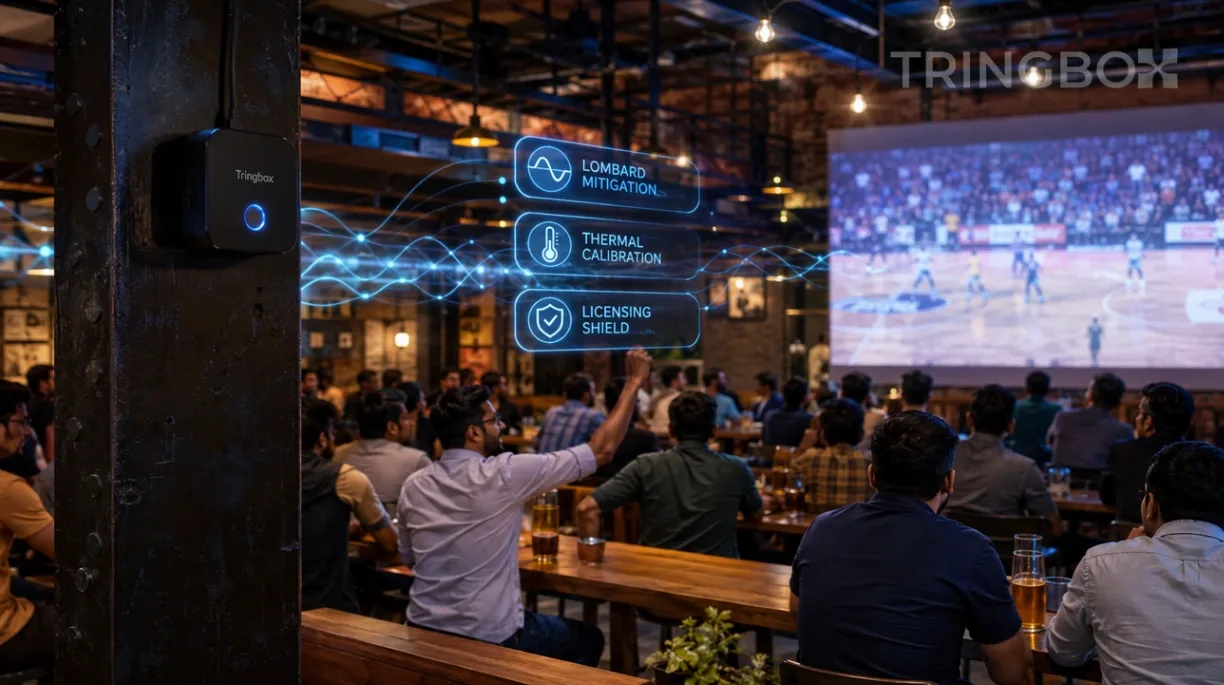
    A 16:9 widescreen cinematic photograph capturing a bustling, high-end industrial sports brewery and hospitality lounge in Bengaluru, India during an evening sports match. The highly detailed background image emphasizes raw exposed brick walls, steel girders, and warm pendant lighting, completely free of any text headers, text overlays, and containing absolutely no girls. A matte-black Tringbox sensor hub is prominently mounted onto an iron structural pillar, emitting a subtle, professional blue indicator light. Clean, translucent holographic data waves tracking environment telemetry float seamlessly in the atmospheric air, displaying clean status indicators such as 'LOMBARD MITIGATION', 'THERMAL CALIBRATION', and 'LICENSING SHIELD'. In the background, a massive abstract projector screen casts a dynamic glow over a diverse group of excited professional male sports fans and businessmen enjoying craft beverages in the optimized, beautifully lit space. Hyper-realistic, 8k resolution, cinematic lighting, real venue space aesthetic.
    Hospitality Strategy15 min read

    India’s IPL Economy Beyond Cricket: Architecting the Match-Day Experience in 2026

    In May 2026, the Indian Premier League (IPL) has transcended its origins as a mere cricket tournament to become India’s most powerful macroeconomic consumer event. The two-month window dictates the financial trajectory of the hospitality, retail, nightlife, and quick-commerce sectors. Match nights trigger massive behavioral shifts fueling a 30% surge in restaurant food and beverage sales, causing immediate spikes in dark store order volumes, and transforming luxury hotel suites into premium fan zones.

    However, capturing this localized economic boom requires far more than installing a large projector screen. Walk into an average sports lounge during a high-stakes run chase, and you will experience a chaotic, stress-inducing environment. Raw broadcast audio, screaming commentators, and blaring commercial breaks create severe cognitive overload, driving patrons to close their tabs early. Today's most lucrative venues are engineering their environments scientifically. Discover how elite venueType operators are leveraging Tringbox Agentic AI to seamlessly bridge the gap between stadium energy and premium dining comfort utilizing acoustic optimization and stringent legal compliance to turn frantic match nights into highly profitable, sustained social rituals.
    May 26, 2026
    Read Article
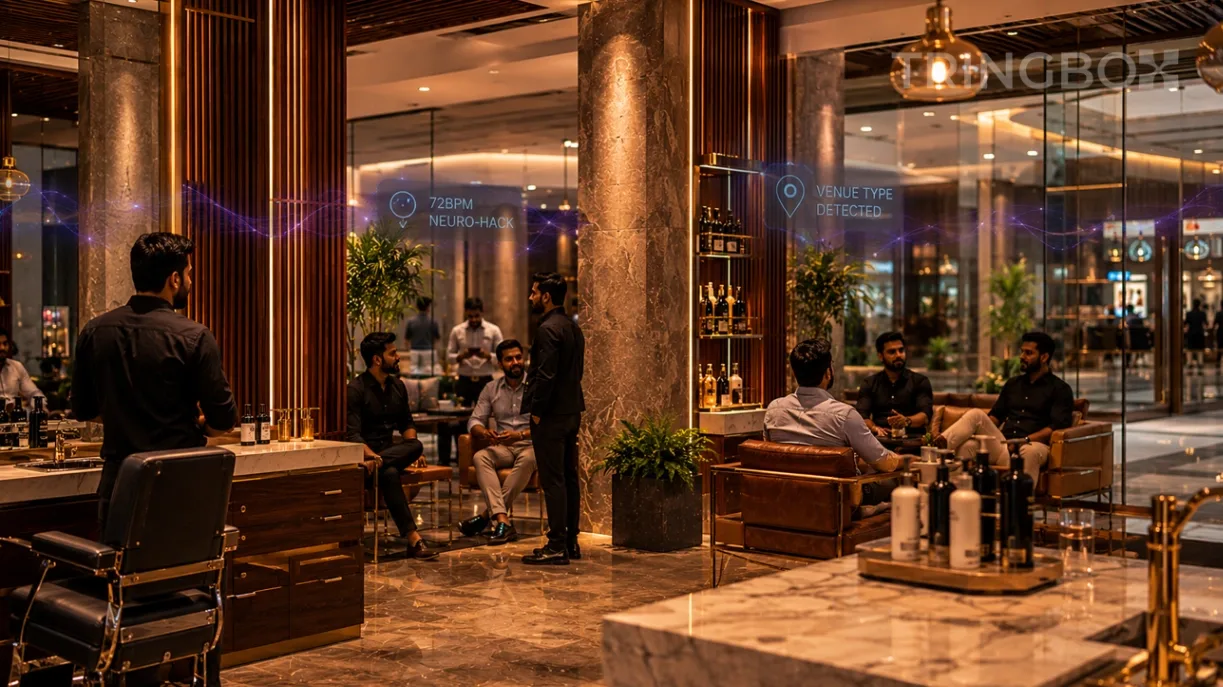
    A 16:9 widescreen cinematic photograph capturing a real, premium commercial space intersecting a high-end salon and luxury mall concourse in India. The highly detailed background image emphasizes raw architectural materials, fluted wood panels, and warm ambient lighting, completely free of any text headers, text overlays, and containing absolutely no girls. A matte-black Tringbox sensor hub is prominently mounted onto a structural stone column, emitting a subtle, professional blue indicator light. Clean, translucent holographic data waves tracking environment telemetry float seamlessly in the atmospheric air, displaying clean status indicators such as VENUE TYPE DETECTED, 72BPM NEURO-HACK, and LICENSING SHIELD. In the background, a diverse group of professional male clients and executives are engaging with the optimized, beautifully lit space. Hyper-realistic, 8k resolution, cinematic lighting, real venue space aesthetic.
    Retail Technology & Strategy15 min read

    Hyper-Personalized Music: How Agentic AI is Rewiring Commercial Spaces in 2026

    In May 2026, relying on a static, looped playlist in a commercial environment is the equivalent of operating without a centralized sales strategy. The modern physical consumer demands an ecosystem that actively responds to their physiological and emotional state. As enterprise brands fight to maximize physical footfall against e-commerce convenience, the strategic deployment of Hyper-Personalized Music has transitioned from a theoretical concept into a foundational operational mandate.

    Through the integration of live environmental sensors, biometric data, and intelligent edge-computing, commercial real estate is becoming completely self-aware. Facilities are no longer just playing audio; they are deploying Tringbox Agentic AI to autonomously adapt acoustic output based on live weather patterns, crowd density, time of day, and precise sales behavior. Discover how leading operators across gyms, luxury hotels, sprawling malls, premium salons, and high-energy sports lounges are weaponizing music psychology to expand dwell time, increase conversion optimization, and maintain an impenetrable shield against aggressive B2B licensing audits.
    May 26, 2026
    Read Article
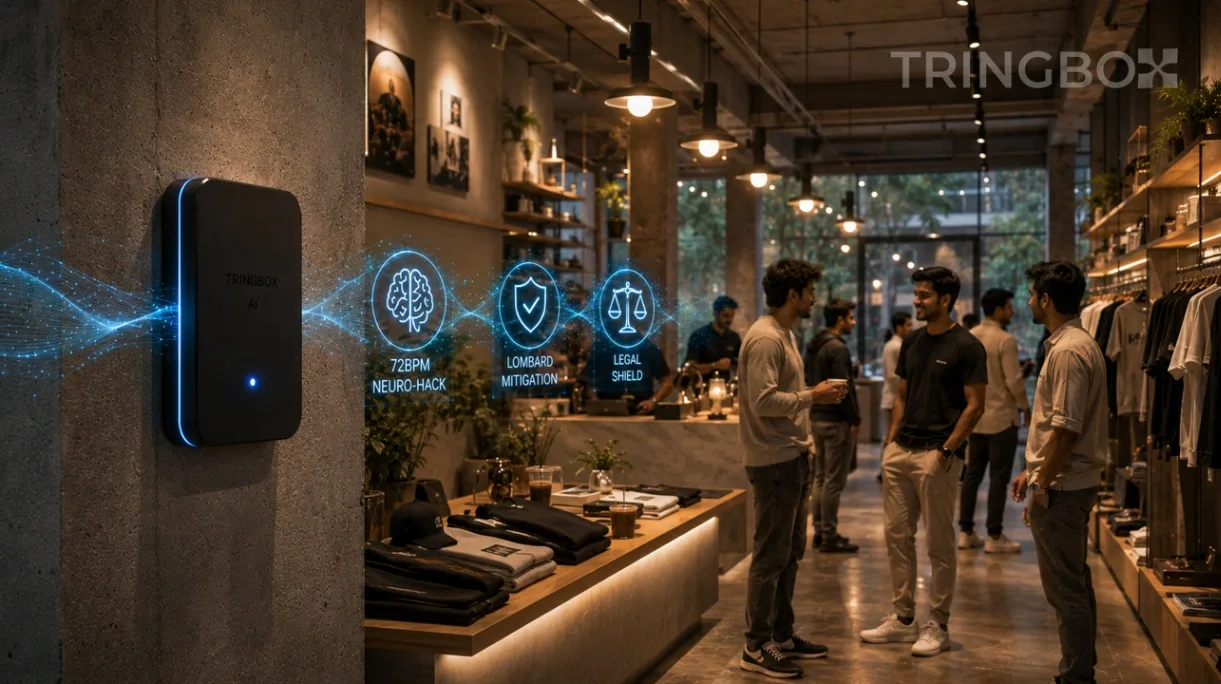
    A 16:9 widescreen cinematic photograph capturing a premium, physical retail pop-up and cafe owned by a digital creator in India. The highly detailed background image emphasizes modern, aesthetic architectural lines, warm ambient lighting, and sleek merchandising displays, completely free of any text overlays and containing no girls. A matte-black Tringbox sensor hub is mounted elegantly onto a textured concrete wall, emitting a subtle, professional blue indicator light. Clean, translucent holographic data waves tracking environment telemetry float seamlessly in the atmospheric air, displaying clean status indicators such as 72BPM NEURO-HACK, LOMBARD MITIGATION, and LEGAL SHIELD. In the background, a diverse group of professional male creators and community members are networking comfortably, completely immersed in the optimized environment. Hyper-realistic, 8k resolution, cinematic lighting.
    Consumer Trends & Strategy10 min read

    The Creator Economy 2.0: Evolving from Influencers to Enterprise Businesses in 2026

    In May 2026, the creator economy has crossed a profound threshold. The era of the one-dimensional influencer relying entirely on algorithmic ad revenue is officially dead. We have entered the Creator Economy 2.0. Today, digital creators operate as sophisticated, diversified enterprise brands. They are no longer just producing content; they are launching private subscription communities, deploying proprietary SaaS tools, executing complex brand licensing deals, and leveraging AI-generated workflows to scale their global output.

    However, as these digital-first brands rapidly expand their empires into physical real estate launching creator-owned cafes, exclusive community meetups, and experiential retail pop-ups they immediately collide with the strict regulatory realities of the physical world. A creator cannot simply plug a consumer streaming app into the speakers of their physical pop-up without facing devastating copyright litigation. To successfully translate a highly specific digital aesthetic into a tactile physical environment, these new enterprise creators are deploying Tringbox Agentic AI. Discover how algorithmic sensory architecture and robust legal compliance are allowing micro-creators and massive digital brands to monetize their physical spaces with absolute precision.
    May 24, 2026
    Read Article
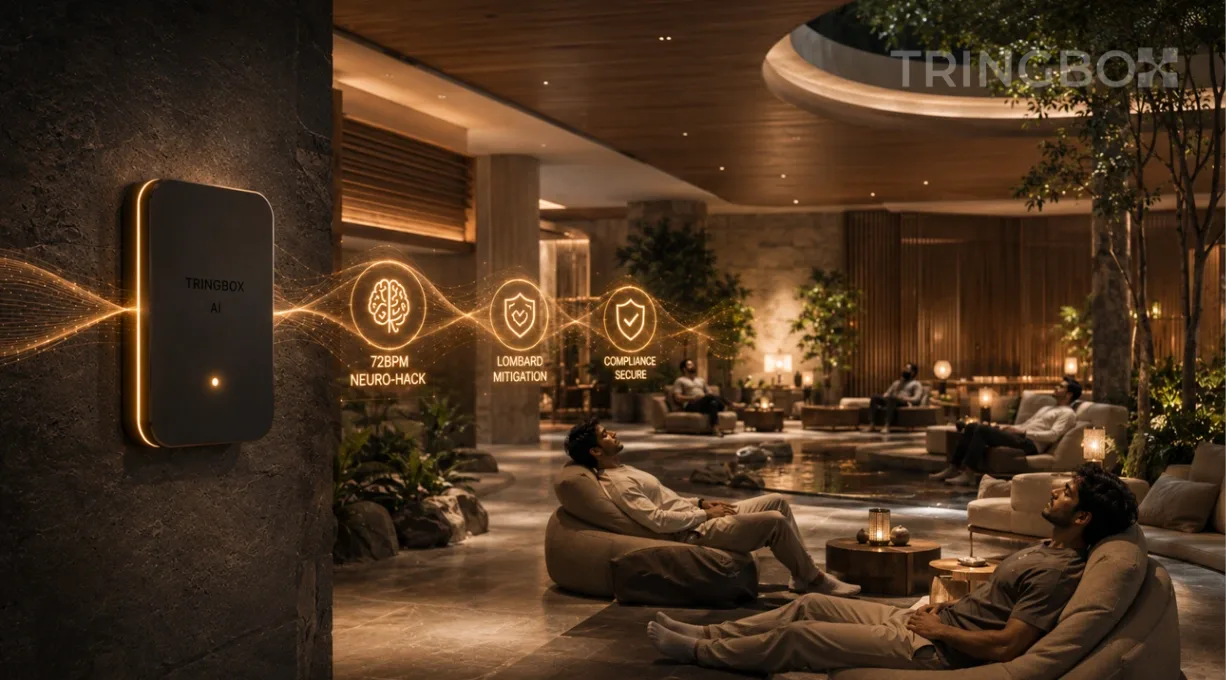
    A 16:9 widescreen cinematic photograph capturing a premium, ultra-luxury wellness club and low-stimulation digital detox lounge in India. The highly detailed background image emphasizes minimalist, wabi-sabi architectural lines, warm natural wood textures, and soft diffused lighting, completely free of any text overlays and containing no girls. A sleek, matte-black Tringbox sensor hub is mounted elegantly onto a textured stone wall, emitting a subtle, calming amber indicator light. Clean, translucent holographic data waves tracking environment telemetry float seamlessly in the atmospheric air, displaying clean status indicators such as 72BPM NEURO-HACK, LOMBARD MITIGATION, and COMPLIANCE SECURE. In the background, a diverse group of professional male executives and younger Gen Z patrons are sitting in deep relaxation, completely disconnected from devices and enjoying the restorative space. Hyper-realistic, 8k resolution, cinematic lighting.
    Consumer Trends & Strategy15 min read

    The New Luxury: Silence, Digital Detox, and Emotional Wellness Design in 2026

    In May 2026, the definition of premium luxury has fundamentally inverted. For decades, commercial brands equated luxury with abundance high-stimulation environments, aggressive sensory marketing, and relentless digital connectivity. Today, that paradigm is obsolete. The modern consumer, chronically over-stimulated and facing unprecedented levels of digital burnout, now views 'quiet' as the ultimate luxury commodity.

    This shift has given rise to the Digital Detox and Slow Living movements, driving a massive architectural pivot toward low-stimulation, mindful spaces. From elite wellness recovery clubs to premium retail boutiques, the goal is no longer to excite the nervous system, but to actively soothe it. However, achieving true environmental calm is not as simple as turning off the music; a completely silent room is sterile, clinical, and often anxiety-inducing. Discover how industry leaders are utilizing Tringbox Agentic AI to execute precise Emotional Wellness Design, replacing chaotic noise with highly engineered, restorative soundscapes that foster deep cognitive sanctuary while maintaining absolute commercial legal compliance.
    May 24, 2026
    Read Article
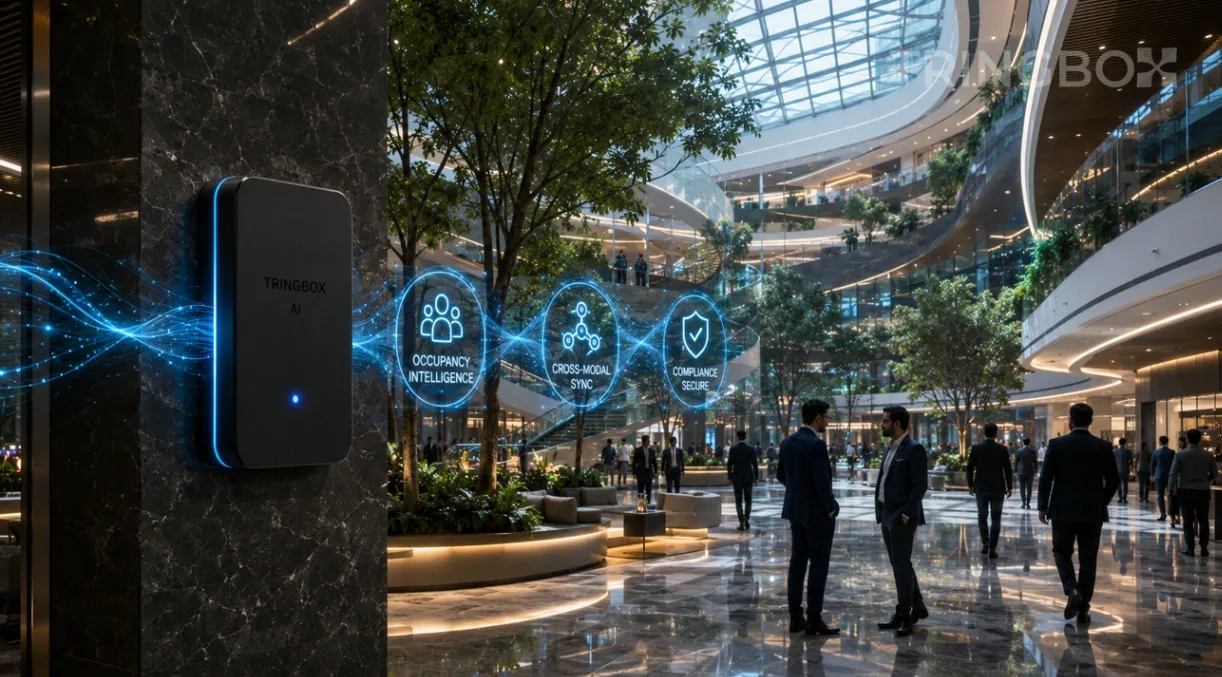
    A 16:9 widescreen cinematic photograph capturing the grand atrium of a futuristic, premium Indian smart building encompassing retail and corporate spaces. The highly detailed background image emphasizes sweeping, biophilic architectural lines, massive glass ceilings, and automated adaptive lighting, completely free of any text overlays and containing no girls. A sleek, matte-black Tringbox sensor hub is mounted neatly onto a structural marble column, emitting a subtle, professional blue indicator light. Clean, translucent holographic data waves tracking environment telemetry float seamlessly in the atmospheric air, displaying clean status indicators such as OCCUPANCY INTELLIGENCE, CROSS-MODAL SYNC, and COMPLIANCE SECURE. In the background, a diverse group of professional male executives and travelers are moving fluidly through the optimized, stress-free space. Hyper-realistic, 8k resolution, cinematic lighting.
    Retail Technology & Architecture16 min read

    Smart Buildings & Emotional Architecture: How AI is Rewiring Commercial Real Estate in 2026

    In May 2026, commercial real estate developers and enterprise facility managers have realized that constructing a physically stunning building is no longer enough. The traditional architectural model where lighting, HVAC, and background music operate as isolated, static utilities has been rendered obsolete. Today, the most valuable commercial spaces are designed as emotionally responsive ecosystems. Driven by deep occupancy intelligence and biophilic data, modern malls, airports, corporate offices, and hospitality hubs now actively read the psychological states of their occupants and autonomously adapt to optimize human comfort.

    At the core of this transformation is the rejection of the "dumb playlist." Blaring generic, uncalibrated music across a multi-million-dollar intelligent facility creates severe sensory friction, actively undermining advanced lighting and fragrance systems. To bridge this gap, visionary architects are integrating Tringbox Agentic AI directly into the building's central nervous system. By treating audio as dynamic spatial software, properties can deploy precise mood-based automation, ensuring that the auditory environment seamlessly aligns with live environmental sensors to engineer profound cognitive comfort and protect the asset with an impenetrable commercial licensing shield.
    May 23, 2026
    Read Article
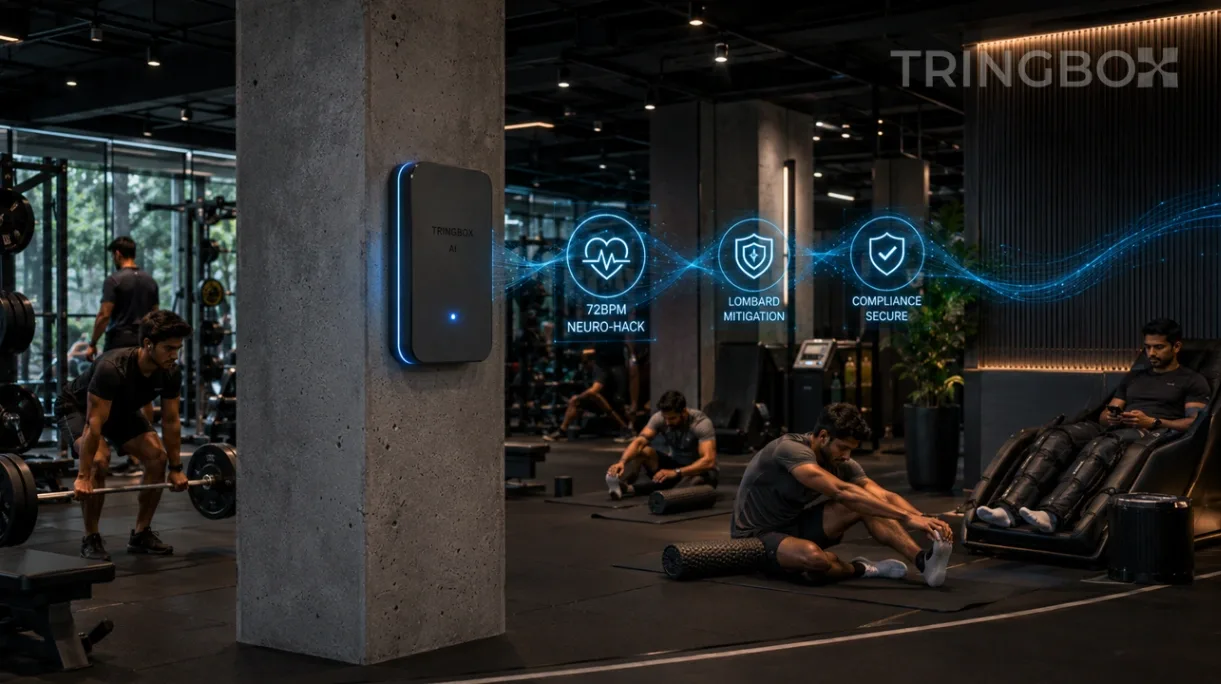
    A 16:9 widescreen cinematic photograph capturing a premium, high-tech enterprise fitness facility and wellness club in India. The highly detailed background image emphasizes sleek, modern architectural lines, dark matte finishes, and premium lifting equipment, completely free of any text overlays and containing no girls. A matte-black Tringbox sensor hub is mounted neatly onto a structural concrete column near the recovery zone, emitting a subtle, professional blue indicator light. Clean, translucent holographic data waves tracking environment telemetry float seamlessly in the atmospheric air, displaying clean status indicators such as 72BPM NEURO-HACK, LOMBARD MITIGATION, and COMPLIANCE SECURE. In the background, a diverse group of athletic, professional male members are engaged in focused workouts and deep recovery stretching, completely immersed in the optimized environment. Hyper-realistic, 8k resolution, cinematic lighting.
    Wellness & Fitness Strategy15 min read

    The Future of Fitness: Neurowellness and Biometric Audio Engineering in 2026

    In May 2026, the traditional fitness facility model characterized by booming, uncalibrated top-40 playlists and chaotic acoustic environments is operationally obsolete. The industry has aggressively pivoted toward Neurowellness, a multidisciplinary approach that treats environmental sound not as a background utility, but as a direct biological performance enhancer. Enterprise gyms, boutique studios, and luxury health clubs are realizing that cognitive fatigue is just as detrimental to member retention as physical exhaustion.

    As members increasingly integrate biometric wearables to track their physiological states, they expect their physical workout environment to be equally intelligent and adaptive. Pumping aggressive, high-BPM tracks across an entire 20,000-square-foot facility creates massive sensory dissonance, driving up cortisol levels in recovery zones and triggering severe noise fatigue on the lifting floor. Discover how industry leaders are deploying Tringbox Agentic AI to segment their spatial audio, mitigate acoustic chaos, and engineer adaptive workout environments that scientifically regulate human emotion while providing an impenetrable corporate shield against aggressive commercial licensing audits.
    May 23, 2026
    Read Article
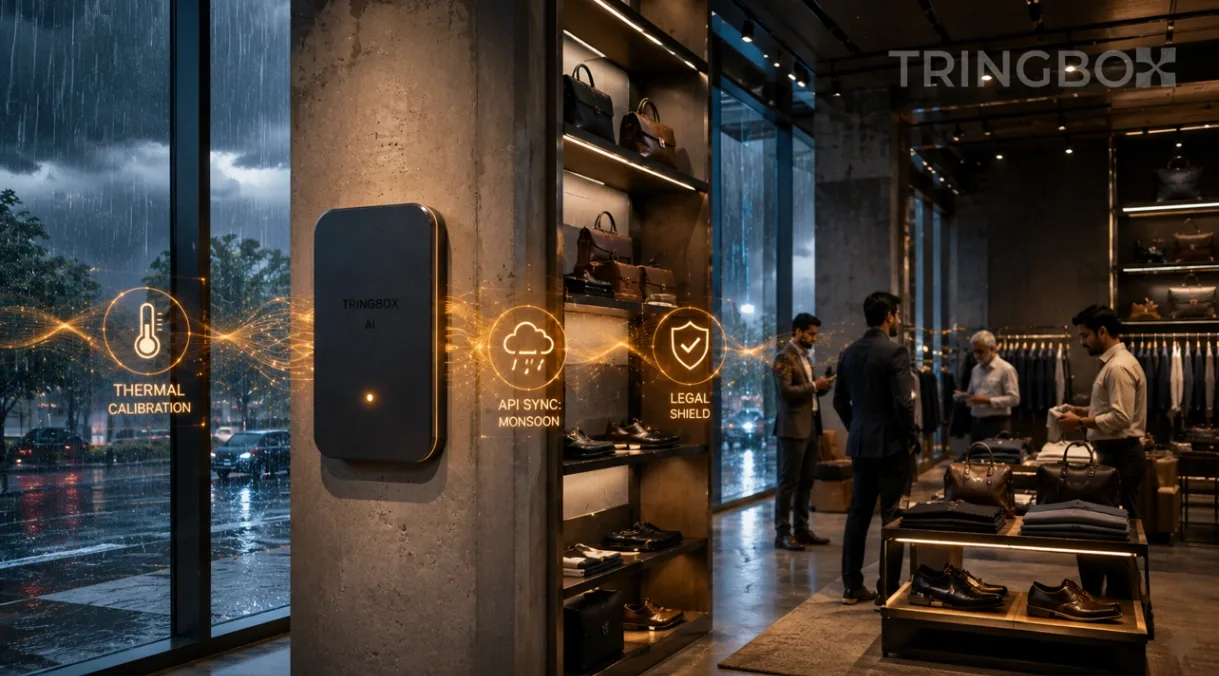
    A 16:9 widescreen cinematic photograph capturing a premium, high-end Indian commercial retail environment with massive glass windows showing a heavy monsoon rainstorm outside. The highly detailed background image emphasizes modern architectural lines and high-end interior textures, completely free of any text overlays and containing no girls. A matte-black Tringbox sensor hub is mounted neatly onto a structural concrete pillar, emitting a subtle, warm amber indicator light. Clean, translucent holographic data waves tracking environment telemetry float seamlessly in the atmospheric air, displaying metrics such as THERMAL CALIBRATION, API SYNC: MONSOON, and LEGAL SHIELD. In the background, a diverse group of professional male shoppers and older patrons are browsing comfortably, completely relaxed and seeking refuge in the optimized, beautifully lit space. Hyper-realistic, 8k resolution, cinematic lighting.
    Retail Technology14 min read

    Weather-Responsive Commerce: How Predictive AI and Sensory Architecture Drive Retail in 2026

    In May 2026, extreme climatic shifts are no longer just meteorological events; they are the primary architects of spontaneous consumer behavior. Across the Indian subcontinent, a sudden pre-monsoon downpour in Mumbai or an intense, dry heatwave in Delhi fundamentally alters foot traffic patterns, purchasing stamina, and baseline emotional states within minutes.

    Historically, retail and hospitality venues operated as static environments offering the exact same lighting, temperature, and auditory experience regardless of the chaos happening outside their doors. Today, this rigidity is a massive operational failure. The industry has aggressively pivoted toward Weather-Responsive Commerce. By deploying predictive retail systems and edge-computing sensor networks, spaces autonomously adapt their sensory output to counteract external climatic stressors. Discover how leading brands are utilizing Tringbox Agentic AI to seamlessly integrate live weather APIs with acoustic engineering turning environmental friction into extended dwell time, deep cognitive comfort, and protected commercial revenue.
    May 22, 2026
    Read Article
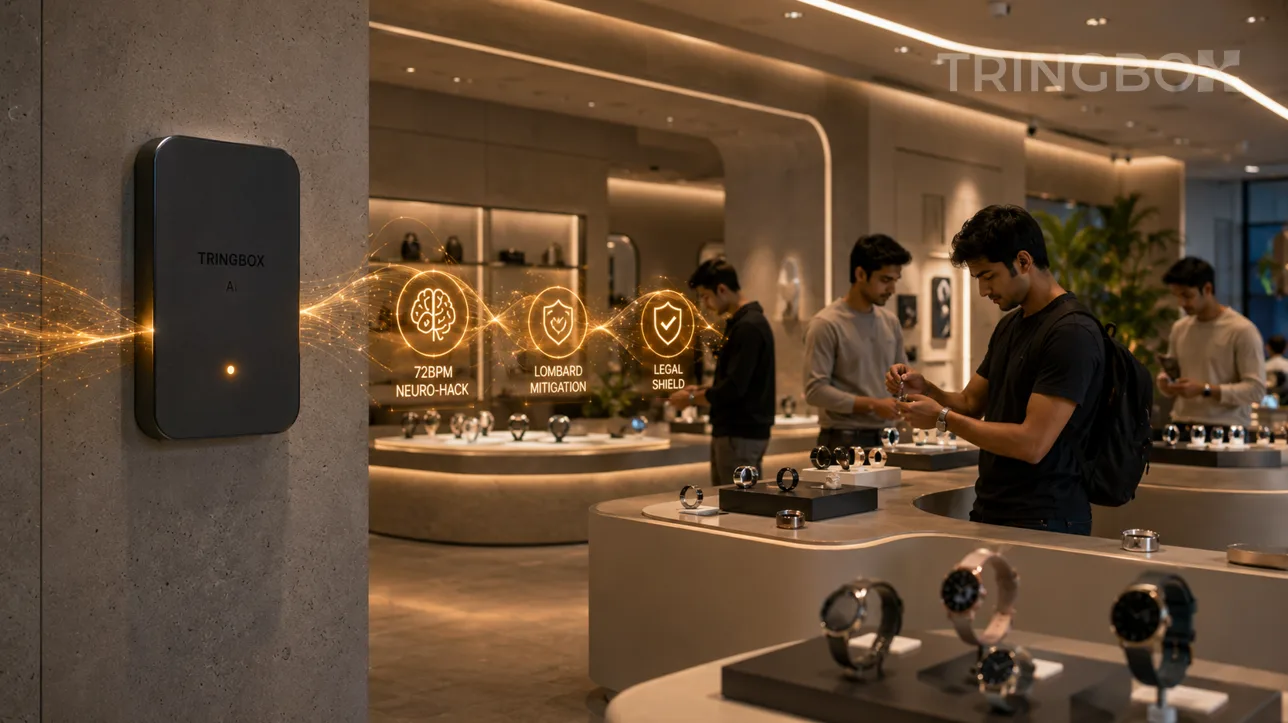
    A 16:9 widescreen cinematic photograph capturing a premium, high-end consumer electronics boutique in India tailored for 'Cute Tech' and aesthetic wearables. The highly detailed background image emphasizes minimalist architectural lines, soft ambient lighting, and sleek display tables, completely free of any text overlays and containing no girls. A matte-black Tringbox sensor hub is mounted neatly onto a structural concrete wall, emitting a subtle, warm amber indicator light. Clean, translucent holographic data waves tracking environment telemetry float seamlessly in the atmospheric air, displaying metrics such as 72BPM NEURO-HACK, LOMBARD MITIGATION, and LEGAL SHIELD. In the background, a diverse group of professional male Gen Z shoppers are browsing comfortably, interacting with smart rings and AI wearables in the beautifully lit space. Hyper-realistic, 8k resolution, cinematic lighting.
    Consumer Trends & Strategy14 min read

    The 'Cute Tech' Explosion: Why Gen Z Demands Emotional Hardware and How Retailers Must Adapt in 2026

    In May 2026, the consumer electronics sector is undergoing a massive aesthetic and psychological pivot. Technology products are no longer marketed purely on processing power or battery life; they have evolved into fashion statements and emotional accessories. This phenomenon widely dubbed 'Cute Tech' sees Gen Z consumers forming deep emotional attachments to AI wearables, pastel smart rings, and designer over-ear headphones.

    However, selling emotionally driven hardware requires a completely different environmental strategy than selling sterile computing equipment. The traditional consumer electronics showroom, historically characterized by harsh fluorescent lighting and disjointed, aggressive background noise, is fatal to the 'Cute Tech' aesthetic. To monetize this demographic shift, retailers must transform their physical spaces into immersive, fashion-forward boutiques. Discover how enterprise electronics brands are deploying Tringbox Agentic AI to engineer hyper-targeted sensory environments, utilizing biometric audio and advanced legal compliance to bridge the gap between silicon hardware and human emotion.
    May 22, 2026
    Read Article
    A 16:9 widescreen cinematic photograph capturing a premium Indian corporate and commercial retail environment. The highly detailed background image emphasizes clean architectural lines and high-end interior textures, completely free of any text overlays and containing no girls. A matte-black Tringbox sensor hub is mounted neatly onto a structural marble column, emitting a subtle, professional blue indicator light. Clean, translucent holographic data waves tracking environment telemetry float seamlessly in the atmospheric air, displaying clean status indicators such as LEGAL SHIELD and COMPLIANCE SECURE. In the background, a diverse group of professional male executives and older business owners are engaged in relaxed, confident conversation within the modern, well-lit commercial space. Hyper-realistic, 8k resolution, cinematic lighting.
    Regulatory & Legal Risk Strategy15 min read

    The Future of Commercial Music Licensing: Navigating Copyright Risks and Automated Compliance Systems

    The commercial real estate and retail landscape in May 2026 faces an unprecedented legal crunch. Corporate operators can no longer treat background audio as an afterthought or a minor operational utility.

    As regulatory bodies globally and locally intensify their audit frameworks, traditional shortcuts ranging from standard consumer streaming accounts to gray-market royalty-free lists are collapsing under legal scrutiny. Physical commercial spaces are increasingly exposed to catastrophic copyright litigation, copyright trolling, and massive statutory penalties. This comprehensive deep dive examines how smart brands are trading vulnerable manual processes for automated compliance networks, ensuring absolute indemnification while turning music into an optimized environmental software asset powered by Tringbox Agentic AI.
    May 21, 2026
    Read Article
    A 16:9 widescreen cinematic photograph capturing a premium, ultra-luxury Indian resort lobby and wellness center. The highly detailed background image highlights organic, sweeping architectural lines, natural stone textures, and biophilic design elements, containing absolutely no text overlays and no girls. A sleek, metallic Tringbox sensor hub is elegantly integrated into a textured wooden feature wall, emitting a subtle, warm amber light. Clean, translucent holographic data waves tracking environment telemetry float seamlessly in the atmospheric air, displaying metrics such as THERMAL SYNC, 72BPM NEURO-HACK, and COMPLIANCE SECURE. In the background, a diverse group of affluent, professional male travelers and refined older guests are lounging comfortably, completely relaxed by the optimized environment. Hyper-realistic, 8k resolution, cinematic lighting.
    Hospitality Strategy16 min read

    The Data-Driven Guest Journey: How AI and Sensory Architecture are Rewiring Luxury Hospitality in 2026

    In May 2026, the luxury hospitality playbook has undergone a fundamental paradigm shift. Impeccable service, high-thread-count linens, and Michelin-star room service are no longer competitive differentiators; they are baseline commodities. Today, elite hotel groups and wellness resorts compete on a far more complex metric: Emotional Memory. To engineer this, hospitality leaders are abandoning static operational models in favor of deep, data-driven sensory architecture.

    Through the integration of environmental sensors, biometric feedback, and Agentic AI, modern hotels are optimizing scent, sound, and thermal dynamics in real-time to create hyper-personalized guest journeys. The lobbies, transit corridors, and fine-dining spaces of 2026 operate as responsive, living ecosystems. At the core of this transformation is the deployment of autonomous sensory infrastructure, such as the Tringbox Agentic AI engine. By systematically replacing disjointed background playlists with dynamically engineered acoustic environments, hospitality brands are physically lowering guest cortisol levels, syncing with live environmental variables, and ensuring bulletproof corporate legal compliance on a global scale.

    May 21, 2026
    Read Article

    Trusted by Industry Leaders

    Recognized by leading innovative platforms

    Tringbox recognized by NVIDIA Inception

    NVIDIA Inception

    AI Innovation Program

    Tringbox recognized by MongoDB for Startups

    MongoDB for Startups

    Database & Infrastructure Support

    Tringbox recognized by AWS Startups

    AWS Startups

    Cloud Computing Resources

    Tringbox recognized by Salesforce for Startups

    Salesforce for Startups

    Business Growth Platform

    What is Tringbox InStore AI Music

    Tringbox InStore AI Music is a smart music system for shops, cafes, offices, gyms, and public spaces. Instead of playing the same playlist every day, it automatically plays the right music based on what is happening in your space at that moment. You don't need to change anything, music adjusts on its own.

    What Tringbox Does

    Real Time Environment Reading

    Understands what customers emotionally need at every moment

    Automatic Music Selection

    Continuously adapting the perfect soundtrack throughout the day

    Effortless Ambience

    No playlists, no manual switching, no guesswork just magic

    Discover Your Perfect Ambiance

    Research & Evidence

    Science Behind Tringbox

    Neuroscience research on soundscapes

    0%

    Dwell Time

    More browsing

    Lower BPM music triggers dopamine release.

    Milliman, 1982 • Journal of Marketing
    0%

    Perception

    Premium feel

    Familiar harmonics enhance trust.

    North & Hargreaves, 1998
    0%

    Experience

    Repeat visits

    Oxytocin release creates familiarity.

    Kellaris & Kent, 1992
    0%

    Conversion

    Impulse buys

    Dopamine improves reward anticipation.

    Mattila & Wirtz, 2001

    How to Get Started

    Transform your venue in 4 simple steps

    1

    Subscribe to Tringbox

    Choose a plan and activate your subscription

    2

    Share Your Store Details

    Our team helps you in a quick onboarding call

    3

    AI Training (Upto 72 Hrs)

    We tune the engine specifically for your brand

    4

    Login & Play

    No hardware needed. Works on any device.

    How Tringbox is Different

    Adaptive music for any environment

    Feature
    Traditional
    Tringbox AI
    Additional Hardware

    Yes

    No

    Context Awareness (Temp, Weather)

    No

    Yes

    Real Time AI Music

    No

    Yes

    Neuroscience Based

    No

    Yes

    Platform Agnostic

    Limited

    Yes

    High Music Repitition

    Yes

    No

    Large Music Library

    Limited

    300K+

    No hardware. No setup. No friction.

    Frequently Asked Questions