Tringbox - AI-Powered In-Store Music Engine Logo

    Tringbox

    InStore AI Music

    Acoustics

    The Lombard Effect: Why Your Café is Too Loud (And How AI Volume Normalization Fixes It)

    Discover the science behind the chaotic restaurant noise loop and learn how AI volume control creates a perfectly conversational, highly profitable dining atmosphere.

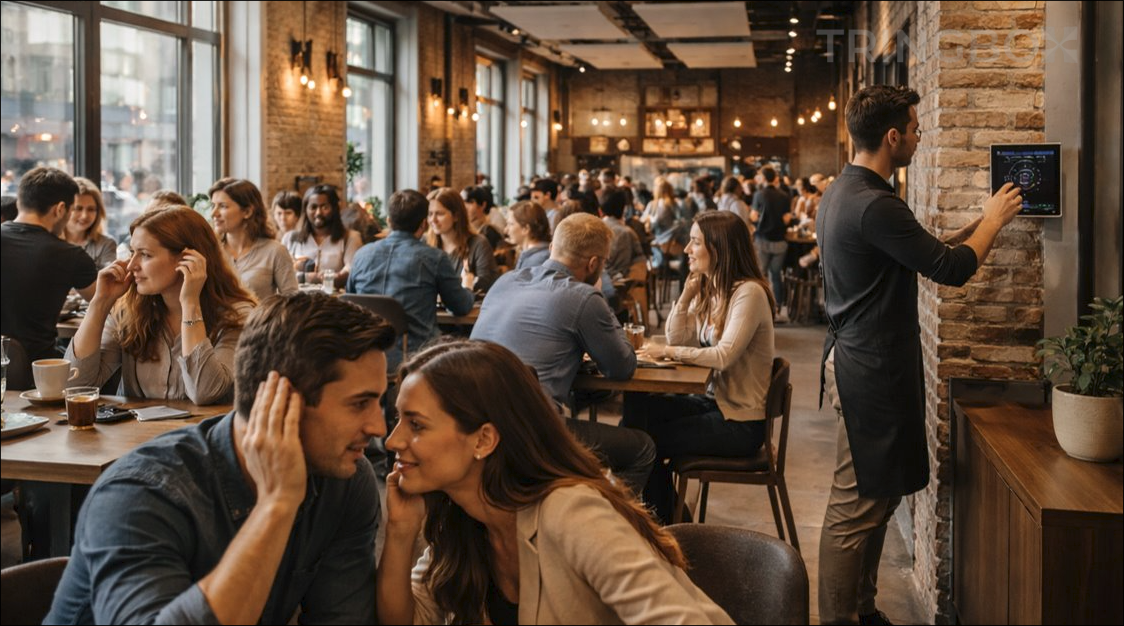
    A well-designed, bustling modern cafe with patrons engaged in comfortable, relaxed conversations over perfectly balanced background music.

    Have you ever walked into a beautifully designed café expecting a relaxing afternoon coffee, only to find yourself shouting across the table just to be heard by your companion? You leave with a mild headache, feeling physically exhausted, and you vow never to return for a business meeting or a casual date. This chaotic, deafening environment is rarely a deliberate choice by the management. It is the result of a devastating acoustic phenomenon known as the Lombard Effect. When the foundational background music in a commercial space is not strictly regulated, a destructive cycle begins. A single sudden volume spike from an unmastered track forces the patrons to raise their voices. This creates a higher baseline of room noise, which prompts other tables to talk even louder to compensate. Within twenty minutes, the dining room transforms into an unbearable noise loop. For hospitality and retail operators, surviving this acoustic chaos requires mastering the science of background music volume control. By deploying intelligent AI platforms that utilize real-time volume normalization, businesses can permanently break the Lombard loop, ensuring a perfectly conversational and highly profitable environment.

    Understanding the Lombard Effect in Restaurants

  1. The Lombard Effect is an involuntary biological response deeply hardwired into human communication. First discovered in 1911, it describes the subconscious tendency of speakers to increase their vocal effort when communicating in loud environments. When the ambient noise in a room rises, a person does not just increase their volume; they actively change their vocal pitch and the rate of their speech to ensure their syllables cut through the competing frequencies. In a crowded commercial venue, this biological reflex is the absolute enemy of a premium customer experience, creating an environment that feels intensely stressful and chaotic.
  2. In a busy hospitality setting, the Lombard effect in restaurants acts as a vicious, escalating feedback loop. It typically begins with a minor acoustic disruption, such as a sudden, loud pop song playing over the sound system, or the clattering of dishes from an open kitchen. The patrons sitting nearest to the disruption subconsciously raise their voices. The table next to them, suddenly finding their own conversation masked by their neighbors, raises their voices in response. This acoustic arms race cascades across the entire dining room. The overarching vibe shifts from a relaxed, premium dining experience into a frantic cafeteria.
  3. The financial consequences of this noise loop are immediate and severe. When customers are forced to shout to be heard, they experience rapid cognitive fatigue. Their dining pace accelerates unconsciously as they rush to finish their meals and escape the overwhelming sensory environment. This premature exit destroys your opportunity to sell high-margin post-meal items like specialty coffees, cocktails, or desserts, devastating your average transaction value for the shift.
  4. The Danger of the 'Shuffle' Button

  5. The primary catalyst for the Lombard Effect in modern cafés and retail showrooms is the reliance on consumer streaming applications like Spotify or YouTube. When a well-meaning barista plugs in an auxiliary cable and hits 'shuffle' on a generic playlist, they are introducing massive acoustic instability into the room. Commercial music is mastered at wildly different volume levels depending on the era, the genre, and the specific audio engineer who mixed the track. A delicate, acoustic indie-folk song from the 1990s will inherently play at a significantly lower perceived volume than a hyper-compressed, bass-heavy electronic pop track released last year.
  6. If your sound system is manually set to a comfortable level for the quiet acoustic track, the subsequent playback of the highly compressed pop song will result in a sudden, jarring volume spike that blasts across the dining room. This singular, unmanaged spike is the exact trigger that initiates the Lombard loop. The patrons immediately raise their voices over the loud track, and when the music eventually transitions back to a quieter song, the human voices remain at the elevated, shouting level. The damage to the room's atmosphere is already done.
  7. To understand how the world's most successful physical brands avoid this jarring inconsistency, you must study the acoustic strategies detailed in the Apple ambient store magic static vs adaptive instore audio analysis. It perfectly illustrates how a continuously smooth, meticulously controlled auditory baseline creates a premium, anxiety-free environment that mass-market, uncurated playlists simply cannot replicate.
  8. The Science of Perceived Loudness

  9. Solving this acoustic instability requires moving beyond the basic volume knob on your amplifier and understanding the complex science of perceived loudness. Human ears do not perceive all frequencies equally. We are biologically highly sensitive to mid-range frequencies, where human speech occurs, and less sensitive to very deep bass or extremely high treble. Therefore, two songs that peak at the exact same decibel level on a technical meter can sound drastically different in their perceived loudness to a customer sitting in your café.
  10. Effective background music volume control must account for these complex perceptual differences. Simply applying a basic digital limiter to a playlist crushes the dynamic range of the music, making everything sound flat, lifeless, and highly fatiguing to the ear. The music loses its emotional resonance and simply becomes a wall of irritating background noise, completely defeating the purpose of curating a premium auditory brand identity.
  11. The ultimate goal is to achieve LUFS (Loudness Units relative to Full Scale) normalization. This advanced audio engineering standard measures the integrated loudness of an entire track over time, ensuring that the perceived energy of the music remains perfectly consistent from one song to the next, regardless of genre or era. Achieving this level of sophisticated audio leveling across thousands of tracks manually is impossible for a commercial business owner.
  12. AI Volume Normalization: The Ultimate Fix

  13. The only permanent solution to the chaotic Lombard loop is the deployment of intelligent, AI-driven volume normalization. Modern enterprise audio platforms actively process every single audio file before it ever hits your venue's speakers. The artificial intelligence mathematically analyzes the integrated LUFS of the track and automatically applies non-destructive gain adjustments. This guarantees that a soft acoustic ballad and a driving electronic anthem are delivered into your physical space at the exact same perceived loudness.
  14. If you want to understand the incredible software architecture and machine learning algorithms that allow this seamless, real-time normalization to occur across thousands of enterprise locations, you must read our deeply technical breakdown on how Tringbox AI picks music for businesses. The system acts as an invisible, highly trained audio engineer constantly riding the faders to ensure the acoustic baseline of your venue remains perfectly stable.
  15. By utilizing this advanced retail sound system design technology, you completely eliminate the sudden volume spikes that trigger the Lombard Effect. Your customers are never forced to raise their voices to compete with the sound system. The dining room remains perfectly conversational, the staff remains relaxed, and the overall vibe of the establishment feels consistently premium, deliberate, and luxuriously comfortable.
  16. Maximizing ROI Through Acoustic Comfort

  17. Mastering your venue's volume control is not just an aesthetic improvement; it is a critical strategy for maximizing your return on investment. Effective cafe noise reduction directly influences how long a customer decides to stay. When patrons can effortlessly converse without straining their vocal cords or leaning aggressively across the table, they naturally relax into their environment. This acoustic comfort drastically extends their dwell time, transforming a quick thirty-minute coffee run into a two-hour business lunch.
  18. In the high-stakes world of fine dining and premium hospitality, acoustic stability is just as important as the quality of the food. If a customer is paying premium prices, they expect a flawless sensory experience. For a deeply comprehensive strategy on managing these specific high-value environments, you must review our ultimate guide on music for restaurant intelligent instore music 2026. It details exactly how flawless volume execution supports staff efficiency while simultaneously maximizing customer satisfaction.
  19. Furthermore, maintaining a consistent, conversational volume level provides essential acoustic privacy. The gentle, normalized background music effectively masks private conversations from neighboring tables without being intrusive. This feeling of intimacy and privacy makes customers feel deeply secure, fostering massive brand loyalty and guaranteeing repeat visits.
  20. Securing Your Sound and Your Legal Compliance

  21. In the pursuit of fixing their venue's audio issues, many hospitality managers attempt to use third-party equalizer apps or consumer streaming platforms. This is a massive operational misstep that exposes the entire business to severe legal liabilities. Playing consumer accounts in a commercial space is a direct violation of strict public performance licensing laws. If you are audited by organizations like PPL or IPRS, the resulting financial penalties for copyright infringement will completely wipe out your seasonal profits.
  22. To safely achieve flawless volume normalization and a premium acoustic environment, businesses absolutely must utilize fully licensed, enterprise-grade B2B platforms. Are you ready to permanently break the Lombard loop, maximize your customers' comfort, and guarantee your legal compliance? Go to Tringbox right now, fill the form and see how the ai will pick best music for that environment given that this is just the demo to showcase the underlying technology.
  23. By embracing smart, AI-driven volume automation, you guarantee that your physical venue remains a highly relevant, deeply engaging, and beautifully conversational destination. You remove the acoustic friction from your customer experience entirely. For more advanced enterprise-level strategies on dominating the modern commercial landscape and optimizing your physical environments, see more guides here on our blogs page.
  24. Conclusion

    The Lombard Effect is a silent killer of hospitality revenue. When your sound system is unpredictable, uncurated, and plagued by sudden volume spikes, your patrons are biologically forced to engage in an exhausting, escalating shouting match. This stressful noise loop destroys the premium vibe of your café, alienates high-value customers, and severely limits your daily profitability. You cannot fix this complex acoustic problem with the volume knob on a basic amplifier or by shuffling a consumer playlist. By implementing intelligent AI volume normalization, you gain absolute mastery over your auditory environment. Every track plays perfectly, the acoustic baseline remains flawless, and your dining room transforms into a comfortably conversational, highly profitable sanctuary. Stop letting chaotic noise dictate your customer experience, and start engineering a flawlessly smooth, legally compliant soundtrack that actively drives your business forward.

    Recommended for you

    A 16:9 widescreen cinematic photograph capturing a bustling, high-end industrial sports brewery and hospitality lounge in Bengaluru, India during an evening sports match. The highly detailed background image emphasizes raw exposed brick walls, steel girders, and warm pendant lighting, completely free of any text headers, text overlays, and containing absolutely no girls. A matte-black Tringbox sensor hub is prominently mounted onto an iron structural pillar, emitting a subtle, professional blue indicator light. Clean, translucent holographic data waves tracking environment telemetry float seamlessly in the atmospheric air, displaying clean status indicators such as 'LOMBARD MITIGATION', 'THERMAL CALIBRATION', and 'LICENSING SHIELD'. In the background, a massive abstract projector screen casts a dynamic glow over a diverse group of excited professional male sports fans and businessmen enjoying craft beverages in the optimized, beautifully lit space. Hyper-realistic, 8k resolution, cinematic lighting, real venue space aesthetic.
    Hospitality Strategy15 min read

    India’s IPL Economy Beyond Cricket: Architecting the Match-Day Experience in 2026

    In May 2026, the Indian Premier League (IPL) has transcended its origins as a mere cricket tournament to become India’s most powerful macroeconomic consumer event. The two-month window dictates the financial trajectory of the hospitality, retail, nightlife, and quick-commerce sectors. Match nights trigger massive behavioral shifts fueling a 30% surge in restaurant food and beverage sales, causing immediate spikes in dark store order volumes, and transforming luxury hotel suites into premium fan zones.

    However, capturing this localized economic boom requires far more than installing a large projector screen. Walk into an average sports lounge during a high-stakes run chase, and you will experience a chaotic, stress-inducing environment. Raw broadcast audio, screaming commentators, and blaring commercial breaks create severe cognitive overload, driving patrons to close their tabs early. Today's most lucrative venues are engineering their environments scientifically. Discover how elite venueType operators are leveraging Tringbox Agentic AI to seamlessly bridge the gap between stadium energy and premium dining comfort utilizing acoustic optimization and stringent legal compliance to turn frantic match nights into highly profitable, sustained social rituals.

    May 26, 2026
    Read Article
    A 16:9 widescreen cinematic photograph capturing a real, premium commercial space intersecting a high-end salon and luxury mall concourse in India. The highly detailed background image emphasizes raw architectural materials, fluted wood panels, and warm ambient lighting, completely free of any text headers, text overlays, and containing absolutely no girls. A matte-black Tringbox sensor hub is prominently mounted onto a structural stone column, emitting a subtle, professional blue indicator light. Clean, translucent holographic data waves tracking environment telemetry float seamlessly in the atmospheric air, displaying clean status indicators such as VENUE TYPE DETECTED, 72BPM NEURO-HACK, and LICENSING SHIELD. In the background, a diverse group of professional male clients and executives are engaging with the optimized, beautifully lit space. Hyper-realistic, 8k resolution, cinematic lighting, real venue space aesthetic.
    Retail Technology & Strategy15 min read

    Hyper-Personalized Music: How Agentic AI is Rewiring Commercial Spaces in 2026

    In May 2026, relying on a static, looped playlist in a commercial environment is the equivalent of operating without a centralized sales strategy. The modern physical consumer demands an ecosystem that actively responds to their physiological and emotional state. As enterprise brands fight to maximize physical footfall against e-commerce convenience, the strategic deployment of Hyper-Personalized Music has transitioned from a theoretical concept into a foundational operational mandate.

    Through the integration of live environmental sensors, biometric data, and intelligent edge-computing, commercial real estate is becoming completely self-aware. Facilities are no longer just playing audio; they are deploying Tringbox Agentic AI to autonomously adapt acoustic output based on live weather patterns, crowd density, time of day, and precise sales behavior. Discover how leading operators across gyms, luxury hotels, sprawling malls, premium salons, and high-energy sports lounges are weaponizing music psychology to expand dwell time, increase conversion optimization, and maintain an impenetrable shield against aggressive B2B licensing audits.

    May 26, 2026
    Read Article
    A 16:9 widescreen cinematic photograph capturing a premium, physical retail pop-up and cafe owned by a digital creator in India. The highly detailed background image emphasizes modern, aesthetic architectural lines, warm ambient lighting, and sleek merchandising displays, completely free of any text overlays and containing no girls. A matte-black Tringbox sensor hub is mounted elegantly onto a textured concrete wall, emitting a subtle, professional blue indicator light. Clean, translucent holographic data waves tracking environment telemetry float seamlessly in the atmospheric air, displaying clean status indicators such as 72BPM NEURO-HACK, LOMBARD MITIGATION, and LEGAL SHIELD. In the background, a diverse group of professional male creators and community members are networking comfortably, completely immersed in the optimized environment. Hyper-realistic, 8k resolution, cinematic lighting.
    Consumer Trends & Strategy10 min read

    The Creator Economy 2.0: Evolving from Influencers to Enterprise Businesses in 2026

    In May 2026, the creator economy has crossed a profound threshold. The era of the one-dimensional influencer relying entirely on algorithmic ad revenue is officially dead. We have entered the Creator Economy 2.0. Today, digital creators operate as sophisticated, diversified enterprise brands. They are no longer just producing content; they are launching private subscription communities, deploying proprietary SaaS tools, executing complex brand licensing deals, and leveraging AI-generated workflows to scale their global output.

    However, as these digital-first brands rapidly expand their empires into physical real estate launching creator-owned cafes, exclusive community meetups, and experiential retail pop-ups they immediately collide with the strict regulatory realities of the physical world. A creator cannot simply plug a consumer streaming app into the speakers of their physical pop-up without facing devastating copyright litigation. To successfully translate a highly specific digital aesthetic into a tactile physical environment, these new enterprise creators are deploying Tringbox Agentic AI. Discover how algorithmic sensory architecture and robust legal compliance are allowing micro-creators and massive digital brands to monetize their physical spaces with absolute precision.

    May 24, 2026
    Read Article
    A 16:9 widescreen cinematic photograph capturing a premium, ultra-luxury wellness club and low-stimulation digital detox lounge in India. The highly detailed background image emphasizes minimalist, wabi-sabi architectural lines, warm natural wood textures, and soft diffused lighting, completely free of any text overlays and containing no girls. A sleek, matte-black Tringbox sensor hub is mounted elegantly onto a textured stone wall, emitting a subtle, calming amber indicator light. Clean, translucent holographic data waves tracking environment telemetry float seamlessly in the atmospheric air, displaying clean status indicators such as 72BPM NEURO-HACK, LOMBARD MITIGATION, and COMPLIANCE SECURE. In the background, a diverse group of professional male executives and younger Gen Z patrons are sitting in deep relaxation, completely disconnected from devices and enjoying the restorative space. Hyper-realistic, 8k resolution, cinematic lighting.
    Consumer Trends & Strategy15 min read

    The New Luxury: Silence, Digital Detox, and Emotional Wellness Design in 2026

    In May 2026, the definition of premium luxury has fundamentally inverted. For decades, commercial brands equated luxury with abundance high-stimulation environments, aggressive sensory marketing, and relentless digital connectivity. Today, that paradigm is obsolete. The modern consumer, chronically over-stimulated and facing unprecedented levels of digital burnout, now views 'quiet' as the ultimate luxury commodity.

    This shift has given rise to the Digital Detox and Slow Living movements, driving a massive architectural pivot toward low-stimulation, mindful spaces. From elite wellness recovery clubs to premium retail boutiques, the goal is no longer to excite the nervous system, but to actively soothe it. However, achieving true environmental calm is not as simple as turning off the music; a completely silent room is sterile, clinical, and often anxiety-inducing. Discover how industry leaders are utilizing Tringbox Agentic AI to execute precise Emotional Wellness Design, replacing chaotic noise with highly engineered, restorative soundscapes that foster deep cognitive sanctuary while maintaining absolute commercial legal compliance.

    May 24, 2026
    Read Article
    A 16:9 widescreen cinematic photograph capturing the grand atrium of a futuristic, premium Indian smart building encompassing retail and corporate spaces. The highly detailed background image emphasizes sweeping, biophilic architectural lines, massive glass ceilings, and automated adaptive lighting, completely free of any text overlays and containing no girls. A sleek, matte-black Tringbox sensor hub is mounted neatly onto a structural marble column, emitting a subtle, professional blue indicator light. Clean, translucent holographic data waves tracking environment telemetry float seamlessly in the atmospheric air, displaying clean status indicators such as OCCUPANCY INTELLIGENCE, CROSS-MODAL SYNC, and COMPLIANCE SECURE. In the background, a diverse group of professional male executives and travelers are moving fluidly through the optimized, stress-free space. Hyper-realistic, 8k resolution, cinematic lighting.
    Retail Technology & Architecture16 min read

    Smart Buildings & Emotional Architecture: How AI is Rewiring Commercial Real Estate in 2026

    In May 2026, commercial real estate developers and enterprise facility managers have realized that constructing a physically stunning building is no longer enough. The traditional architectural model where lighting, HVAC, and background music operate as isolated, static utilities has been rendered obsolete. Today, the most valuable commercial spaces are designed as emotionally responsive ecosystems. Driven by deep occupancy intelligence and biophilic data, modern malls, airports, corporate offices, and hospitality hubs now actively read the psychological states of their occupants and autonomously adapt to optimize human comfort.

    At the core of this transformation is the rejection of the "dumb playlist." Blaring generic, uncalibrated music across a multi-million-dollar intelligent facility creates severe sensory friction, actively undermining advanced lighting and fragrance systems. To bridge this gap, visionary architects are integrating Tringbox Agentic AI directly into the building's central nervous system. By treating audio as dynamic spatial software, properties can deploy precise mood-based automation, ensuring that the auditory environment seamlessly aligns with live environmental sensors to engineer profound cognitive comfort and protect the asset with an impenetrable commercial licensing shield.

    May 23, 2026
    Read Article
    A 16:9 widescreen cinematic photograph capturing a premium, high-tech enterprise fitness facility and wellness club in India. The highly detailed background image emphasizes sleek, modern architectural lines, dark matte finishes, and premium lifting equipment, completely free of any text overlays and containing no girls. A matte-black Tringbox sensor hub is mounted neatly onto a structural concrete column near the recovery zone, emitting a subtle, professional blue indicator light. Clean, translucent holographic data waves tracking environment telemetry float seamlessly in the atmospheric air, displaying clean status indicators such as 72BPM NEURO-HACK, LOMBARD MITIGATION, and COMPLIANCE SECURE. In the background, a diverse group of athletic, professional male members are engaged in focused workouts and deep recovery stretching, completely immersed in the optimized environment. Hyper-realistic, 8k resolution, cinematic lighting.
    Wellness & Fitness Strategy15 min read

    The Future of Fitness: Neurowellness and Biometric Audio Engineering in 2026

    In May 2026, the traditional fitness facility model characterized by booming, uncalibrated top-40 playlists and chaotic acoustic environments is operationally obsolete. The industry has aggressively pivoted toward Neurowellness, a multidisciplinary approach that treats environmental sound not as a background utility, but as a direct biological performance enhancer. Enterprise gyms, boutique studios, and luxury health clubs are realizing that cognitive fatigue is just as detrimental to member retention as physical exhaustion.

    As members increasingly integrate biometric wearables to track their physiological states, they expect their physical workout environment to be equally intelligent and adaptive. Pumping aggressive, high-BPM tracks across an entire 20,000-square-foot facility creates massive sensory dissonance, driving up cortisol levels in recovery zones and triggering severe noise fatigue on the lifting floor. Discover how industry leaders are deploying Tringbox Agentic AI to segment their spatial audio, mitigate acoustic chaos, and engineer adaptive workout environments that scientifically regulate human emotion while providing an impenetrable corporate shield against aggressive commercial licensing audits.

    May 23, 2026
    Read Article
    A 16:9 widescreen cinematic photograph capturing a premium, high-end Indian commercial retail environment with massive glass windows showing a heavy monsoon rainstorm outside. The highly detailed background image emphasizes modern architectural lines and high-end interior textures, completely free of any text overlays and containing no girls. A matte-black Tringbox sensor hub is mounted neatly onto a structural concrete pillar, emitting a subtle, warm amber indicator light. Clean, translucent holographic data waves tracking environment telemetry float seamlessly in the atmospheric air, displaying metrics such as THERMAL CALIBRATION, API SYNC: MONSOON, and LEGAL SHIELD. In the background, a diverse group of professional male shoppers and older patrons are browsing comfortably, completely relaxed and seeking refuge in the optimized, beautifully lit space. Hyper-realistic, 8k resolution, cinematic lighting.
    Retail Technology14 min read

    Weather-Responsive Commerce: How Predictive AI and Sensory Architecture Drive Retail in 2026

    In May 2026, extreme climatic shifts are no longer just meteorological events; they are the primary architects of spontaneous consumer behavior. Across the Indian subcontinent, a sudden pre-monsoon downpour in Mumbai or an intense, dry heatwave in Delhi fundamentally alters foot traffic patterns, purchasing stamina, and baseline emotional states within minutes.

    Historically, retail and hospitality venues operated as static environments offering the exact same lighting, temperature, and auditory experience regardless of the chaos happening outside their doors. Today, this rigidity is a massive operational failure. The industry has aggressively pivoted toward Weather-Responsive Commerce. By deploying predictive retail systems and edge-computing sensor networks, spaces autonomously adapt their sensory output to counteract external climatic stressors. Discover how leading brands are utilizing Tringbox Agentic AI to seamlessly integrate live weather APIs with acoustic engineering turning environmental friction into extended dwell time, deep cognitive comfort, and protected commercial revenue.

    May 22, 2026
    Read Article
    A 16:9 widescreen cinematic photograph capturing a premium, high-end consumer electronics boutique in India tailored for 'Cute Tech' and aesthetic wearables. The highly detailed background image emphasizes minimalist architectural lines, soft ambient lighting, and sleek display tables, completely free of any text overlays and containing no girls. A matte-black Tringbox sensor hub is mounted neatly onto a structural concrete wall, emitting a subtle, warm amber indicator light. Clean, translucent holographic data waves tracking environment telemetry float seamlessly in the atmospheric air, displaying metrics such as 72BPM NEURO-HACK, LOMBARD MITIGATION, and LEGAL SHIELD. In the background, a diverse group of professional male Gen Z shoppers are browsing comfortably, interacting with smart rings and AI wearables in the beautifully lit space. Hyper-realistic, 8k resolution, cinematic lighting.
    Consumer Trends & Strategy14 min read

    The 'Cute Tech' Explosion: Why Gen Z Demands Emotional Hardware and How Retailers Must Adapt in 2026

    In May 2026, the consumer electronics sector is undergoing a massive aesthetic and psychological pivot. Technology products are no longer marketed purely on processing power or battery life; they have evolved into fashion statements and emotional accessories. This phenomenon widely dubbed 'Cute Tech' sees Gen Z consumers forming deep emotional attachments to AI wearables, pastel smart rings, and designer over-ear headphones.

    However, selling emotionally driven hardware requires a completely different environmental strategy than selling sterile computing equipment. The traditional consumer electronics showroom, historically characterized by harsh fluorescent lighting and disjointed, aggressive background noise, is fatal to the 'Cute Tech' aesthetic. To monetize this demographic shift, retailers must transform their physical spaces into immersive, fashion-forward boutiques. Discover how enterprise electronics brands are deploying Tringbox Agentic AI to engineer hyper-targeted sensory environments, utilizing biometric audio and advanced legal compliance to bridge the gap between silicon hardware and human emotion.

    May 22, 2026
    Read Article
    A 16:9 widescreen cinematic photograph capturing a premium Indian corporate and commercial retail environment. The highly detailed background image emphasizes clean architectural lines and high-end interior textures, completely free of any text overlays and containing no girls. A matte-black Tringbox sensor hub is mounted neatly onto a structural marble column, emitting a subtle, professional blue indicator light. Clean, translucent holographic data waves tracking environment telemetry float seamlessly in the atmospheric air, displaying clean status indicators such as LEGAL SHIELD and COMPLIANCE SECURE. In the background, a diverse group of professional male executives and older business owners are engaged in relaxed, confident conversation within the modern, well-lit commercial space. Hyper-realistic, 8k resolution, cinematic lighting.
    Regulatory & Legal Risk Strategy15 min read

    The Future of Commercial Music Licensing: Navigating Copyright Risks and Automated Compliance Systems

    The commercial real estate and retail landscape in May 2026 faces an unprecedented legal crunch. Corporate operators can no longer treat background audio as an afterthought or a minor operational utility.

    As regulatory bodies globally and locally intensify their audit frameworks, traditional shortcuts ranging from standard consumer streaming accounts to gray-market royalty-free lists are collapsing under legal scrutiny. Physical commercial spaces are increasingly exposed to catastrophic copyright litigation, copyright trolling, and massive statutory penalties. This comprehensive deep dive examines how smart brands are trading vulnerable manual processes for automated compliance networks, ensuring absolute indemnification while turning music into an optimized environmental software asset powered by Tringbox Agentic AI.

    May 21, 2026
    Read Article
    A 16:9 widescreen cinematic photograph capturing a premium, ultra-luxury Indian resort lobby and wellness center. The highly detailed background image highlights organic, sweeping architectural lines, natural stone textures, and biophilic design elements, containing absolutely no text overlays and no girls. A sleek, metallic Tringbox sensor hub is elegantly integrated into a textured wooden feature wall, emitting a subtle, warm amber light. Clean, translucent holographic data waves tracking environment telemetry float seamlessly in the atmospheric air, displaying metrics such as THERMAL SYNC, 72BPM NEURO-HACK, and COMPLIANCE SECURE. In the background, a diverse group of affluent, professional male travelers and refined older guests are lounging comfortably, completely relaxed by the optimized environment. Hyper-realistic, 8k resolution, cinematic lighting.
    Hospitality Strategy16 min read

    The Data-Driven Guest Journey: How AI and Sensory Architecture are Rewiring Luxury Hospitality in 2026

    In May 2026, the luxury hospitality playbook has undergone a fundamental paradigm shift. Impeccable service, high-thread-count linens, and Michelin-star room service are no longer competitive differentiators; they are baseline commodities. Today, elite hotel groups and wellness resorts compete on a far more complex metric: Emotional Memory. To engineer this, hospitality leaders are abandoning static operational models in favor of deep, data-driven sensory architecture.

    Through the integration of environmental sensors, biometric feedback, and Agentic AI, modern hotels are optimizing scent, sound, and thermal dynamics in real-time to create hyper-personalized guest journeys. The lobbies, transit corridors, and fine-dining spaces of 2026 operate as responsive, living ecosystems. At the core of this transformation is the deployment of autonomous sensory infrastructure, such as the Tringbox Agentic AI engine. By systematically replacing disjointed background playlists with dynamically engineered acoustic environments, hospitality brands are physically lowering guest cortisol levels, syncing with live environmental variables, and ensuring bulletproof corporate legal compliance on a global scale.

    May 21, 2026
    Read Article

    Trusted by Industry Leaders

    Recognized by leading innovative platforms

    Tringbox recognized by NVIDIA Inception

    NVIDIA Inception

    AI Innovation Program

    Tringbox recognized by MongoDB for Startups

    MongoDB for Startups

    Database & Infrastructure Support

    Tringbox recognized by AWS Startups

    AWS Startups

    Cloud Computing Resources

    Tringbox recognized by Salesforce for Startups

    Salesforce for Startups

    Business Growth Platform

    What is Tringbox InStore AI Music

    Tringbox InStore AI Music is a smart music system for shops, cafes, offices, gyms, and public spaces. Instead of playing the same playlist every day, it automatically plays the right music based on what is happening in your space at that moment. You don't need to change anything, music adjusts on its own.

    What Tringbox Does

    Real Time Environment Reading

    Understands what customers emotionally need at every moment

    Automatic Music Selection

    Continuously adapting the perfect soundtrack throughout the day

    Effortless Ambience

    No playlists, no manual switching, no guesswork just magic

    Discover Your Perfect Ambiance

    Research & Evidence

    Science Behind Tringbox

    Neuroscience research on soundscapes

    0%

    Dwell Time

    More browsing

    Lower BPM music triggers dopamine release.

    Milliman, 1982 • Journal of Marketing
    0%

    Perception

    Premium feel

    Familiar harmonics enhance trust.

    North & Hargreaves, 1998
    0%

    Experience

    Repeat visits

    Oxytocin release creates familiarity.

    Kellaris & Kent, 1992
    0%

    Conversion

    Impulse buys

    Dopamine improves reward anticipation.

    Mattila & Wirtz, 2001

    How to Get Started

    Transform your venue in 4 simple steps

    1

    Subscribe to Tringbox

    Choose a plan and activate your subscription

    2

    Share Your Store Details

    Our team helps you in a quick onboarding call

    3

    AI Training (Upto 72 Hrs)

    We tune the engine specifically for your brand

    4

    Login & Play

    No hardware needed. Works on any device.

    How Tringbox is Different

    Adaptive music for any environment

    Feature
    Traditional
    Tringbox AI
    Additional Hardware

    Yes

    No

    Context Awareness (Temp, Weather)

    No

    Yes

    Real Time AI Music

    No

    Yes

    Neuroscience Based

    No

    Yes

    Platform Agnostic

    Limited

    Yes

    High Music Repitition

    Yes

    No

    Large Music Library

    Limited

    300K+

    No hardware. No setup. No friction.

    Frequently Asked Questions